In 2026, the bottleneck in surgery is no longer a lack of information; it is the fragmentation of information.
A modern surgeon is surrounded by screens: heart rate monitors, laparoscopic feeds, pre-operative CT scans, and robotic control dashboards. The surgeon’s brain acts as the central processor, forced to manually fuse these disparate data streams while simultaneously performing a high-precision physical task.
As I’ve established throughout this series, we have the “Eyes” and the “Brain” to help. But if we deliver that intelligence via another screen on the wall, we are adding to the cognitive load, not reducing it.
To truly “improve outcomes,” as some of our commenters noted in our recent discussion, we must deliver intelligence at the point of action. We must build the Digital Nervous System.
The Shift from Heads-Down to Heads-Up Surgery In my work building Surgical AR teams (notably during my tenure at Arthrex), the primary objective was never “cool visuals.” It was Precision and Focus.
Traditional “Heads-Down” surgery requires a surgeon to look away from the patient to a monitor. This creates a spatial disconnect. Their hands are working in one 3D space, while their eyes are focused on a 2D screen in a different orientation.
Augmented Reality (AR) solves this by achieving “Co-location.”
By using headsets like the HoloLens 2 or Apple Vision Pro, or high-fidelity AR displays, we project the AI’s insights (the tumor margins detected by our CNNs or the instrument paths tracked by YOLO) directly onto the patient’s anatomy.
The Architectural Challenge: Spatial Registration The “magic” of AR in the operating room isn’t the display; it’s the Registration.
This is the hardest architectural hurdle I solve for my clients. How do you align a virtual 3D model (derived from a CT scan) with the physical, pulsating, deforming tissue of a patient with sub-millimeter accuracy?
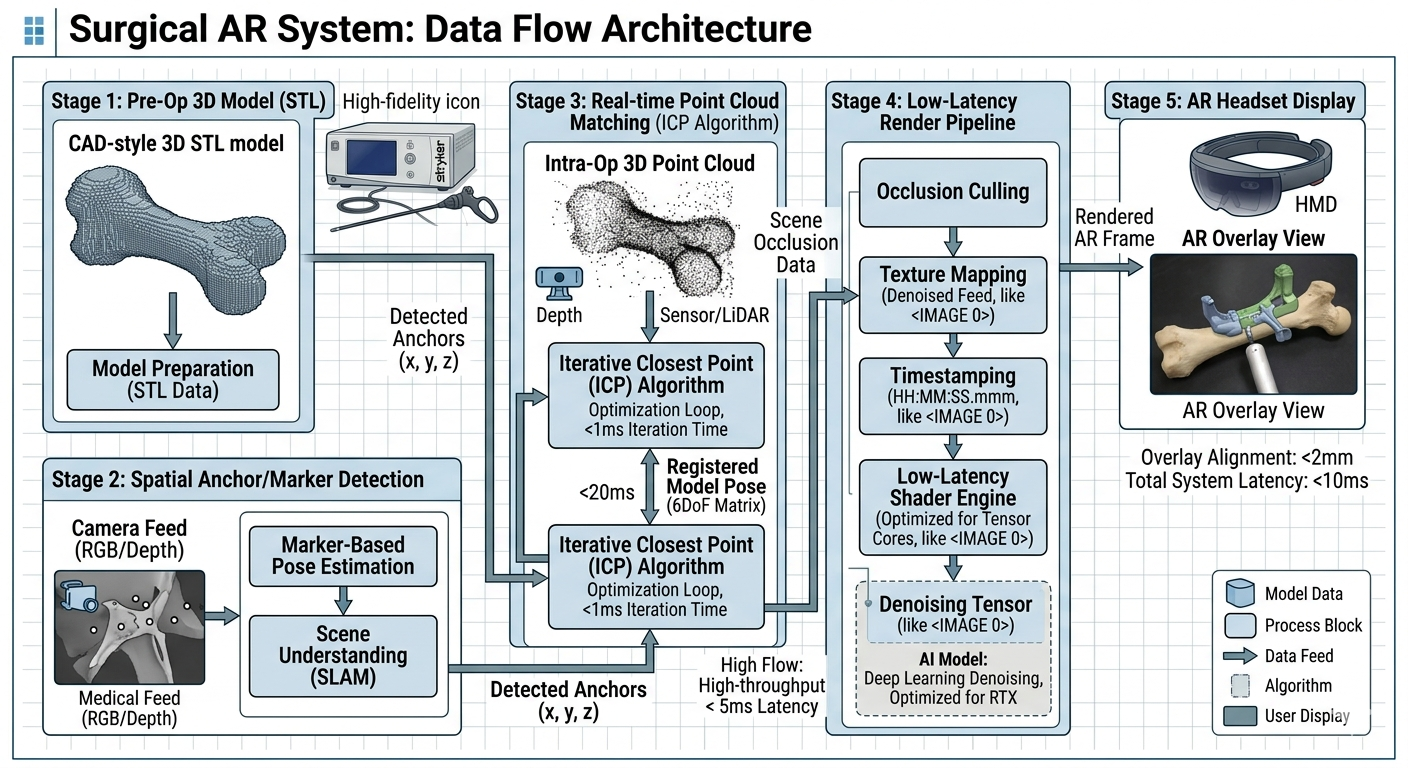
Drawing on my foundation in Applied Algorithms from IIT Bombay, I approach this as a complex coordinate transformation problem. The architecture requires three synchronized layers:
The Perception Layer: Using CV to identify “Spatial Anchors” (either markers or natural anatomical landmarks). The Alignment Layer: Running high-speed Iterative Closest Point (ICP) algorithms to match the real-world point cloud with the virtual model. The Compensation Layer: This is where startup agility is required. We must architect systems that can handle “soft-tissue deformation”—calculating in real-time how the internal organs shift when the surgeon touches them.
Article content ROI: The Economics of Precision Why should a MedTech CEO invest in the Digital Nervous System?
Reduction in Re-operation Rates: By seeing the exact margins of a tumor or the hidden path of a nerve, surgeons can achieve “Total Resection” the first time. Compressed Training Cycles: Resident surgeons can learn complex spatial navigation 30-40% faster when guided by “digital “scaffolding” in the field of view. Standardization of Care: It elevates the performance of every surgeon in the network to the level of the most experienced specialist, reducing institutional liability.
Case Study: Sub-Millimeter Success In a recent project, we moved beyond the prototype phase to architect a system that achieved 2mm and 2-degree accuracy for orthopedic screw placement. By bypassing traditional physical jigs and replacing them with a low-latency AR overlay, we reduced total instrumentation time by nearly 30%, significantly lowering the time the patient spent under anesthesia.
Architecting for the spatial constraints of the OR is a specialized discipline. I have documented the core requirements in my 1-page guide: ‘Architecting High-Precision AR for Clinical Environments’.
Comment “BLUEPRINT”, and I will DM it to you directly.