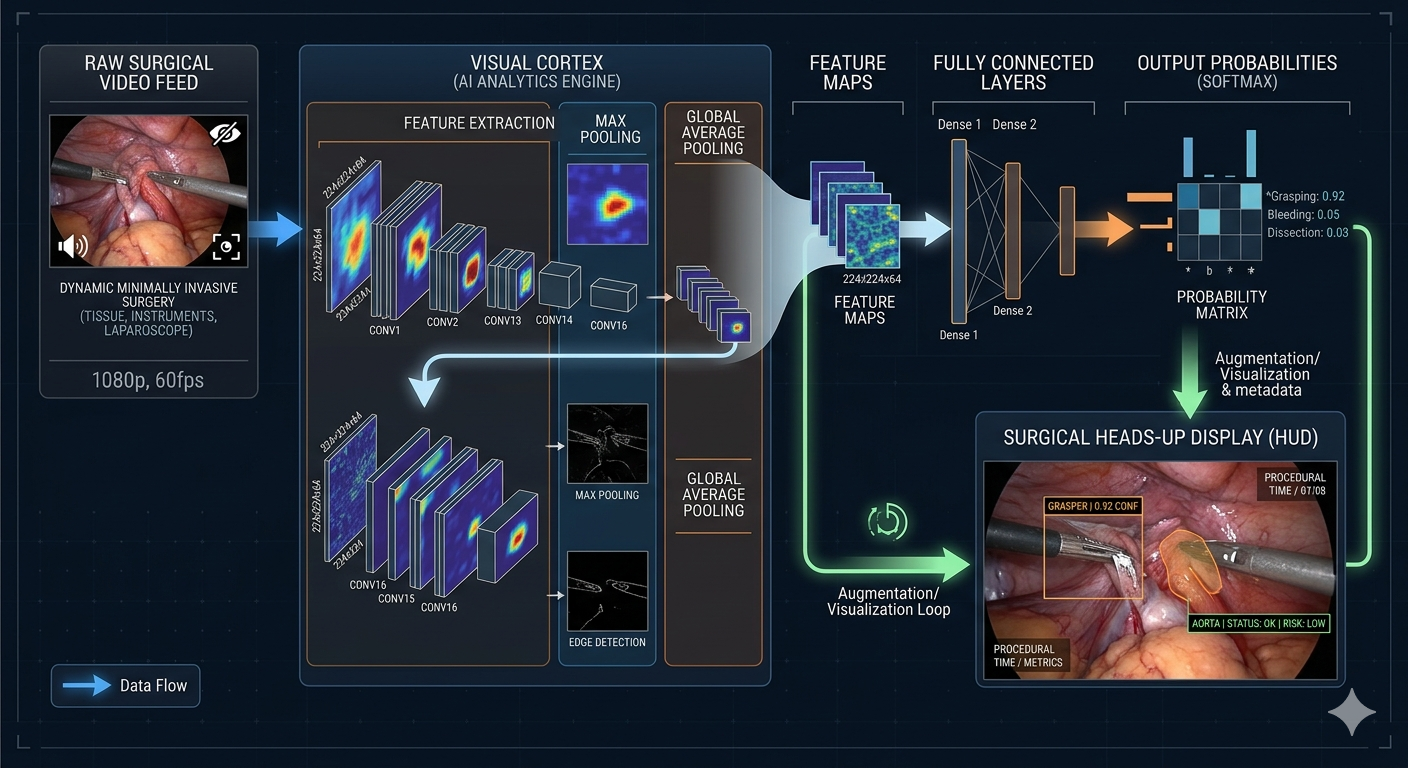
In the previous article, we established that latency is the silent killer of surgical AI. We concluded that computing must happen at the “Edge” to be clinically viable.
But what exactly are we computing?
For decades, computer vision relied on humans writing mathematical rules. We wrote algorithms to find sharp changes in contrast (edges) or specific color thresholds. In a controlled lab, this works. In the operating room—where tissue is obscured by blood, smoke, and glaring light—rigid mathematical rules shatter.
To build the next generation of surgical robotics and diagnostic tools, MedTech executives must abandon rule-based vision and embrace learned perception. We must build a digital visual cortex.
Enter the Convolutional Neural Network (CNN).
The Business Case for Learned Perception in the OR Consider the economic and clinical drain of margin assessment during tumor resections. Surgeons rely on preoperative MRI/CT scans and their own trained eyes to distinguish healthy tissue from cancerous tissue. Often, they must send a “frozen section” to pathology mid-surgery. The patient remains under anesthesia while the surgical team waits 20 to 30 minutes for a verdict.
If the margins aren’t clear, they cut more. If they miss it, the patient faces a traumatic re-operation months later.
What if the laparoscopic camera could highlight dysplastic or cancerous cells in real-time, overlaying a probability heatmap directly onto the surgical monitor?
This isn’t science fiction. It is an architectural engineering challenge.
See content credentials Article content
Architecting the Digital Visual Cortex During my studies in applied algorithms at IIT Bombay, the focus was always on finding the most efficient path to a solution. In my years deploying agile architectures in the startup world, I learned that the most efficient path for visual data is not writing a thousand rules, but letting the machine learn the optimal filters itself.
A CNN does not ask, “Is there a sharp line here?” Instead, it passes the surgical video feed through millions of tiny, learned filters (convolutions).
Early Layers (The Foundation): The network learns to detect basic, universal features: microscopic edges, gradients, and specific tissue textures. Deep Layers (The Synthesis): As the data moves deeper into the network, it combines these basic textures into complex semantic understandings. It learns the visual “signature” of a specific tumor type versus a benign cyst.
The Deployment Reality: Why Off-the-Shelf Fails MedTech innovation teams often make a critical mistake: they download a massive, pre-trained CNN (like ResNet50 or VGG16) built for identifying cats and cars on the internet, and try to fine-tune it for the OR.
This leads to catastrophic failure.
To deploy a CNN for real-time surgical pathology, the architecture must be bespoke:
Hardware-Aware Design: The model architecture must be heavily compressed (Quantization, Pruning) so it can run at 60 Frames Per Second (FPS) on a local Edge GPU inside the surgical tower. Domain-Specific Training: The model cannot be trained on pristine internet images. It must be trained on heavily augmented datasets that simulate camera fog, electrocautery smoke, and specular reflections from wet tissue. Explainability (Grad-CAM): Surgeons do not trust “black boxes.” The architecture must output not just a classification, but a visual heatmap (using techniques like Gradient-weighted Class Activation Mapping) showing exactly which pixels caused the AI to flag the tissue as anomalous.
The Strategic Shift When you architect a CNN for the operating room correctly, you are no longer just selling a medical device. You are selling a reduction in re-operation rates. You are selling surgical confidence. You are selling time.