In Part 6 of this series, we discussed how Convolutional Neural Networks (CNNs) serve as the “Visual Cortex” for surgical AI, allowing machines to classify tissue anomalies that evade the human eye.
But classification—knowing what is in an image—is only half the battle. In the high-stakes environments of the pathology lab and the operating room, we also need to know where it is, and how many there are. And we need to know it instantly.
This is the domain of Object Detection.
The Cost of Cognitive Fatigue Consider a pathologist analyzing a gigapixel whole-slide image (WSI) for mitotic figures to grade a tumor. Or consider a surgical team executing a complex abdominal procedure, responsible for tracking every scalpel, clamp, and surgical sponge to prevent Retained Surgical Items (RSIs)—a “never event” that costs hospitals millions in liability.
Human vision is remarkable, but it suffers from severe cognitive fatigue when subjected to repetitive search tasks in visually chaotic environments. We are forcing our most expensive and highly trained medical personnel to act as biological search engines.
Architectural Cross-Pollination: Bringing Industrial Speed to Healthcare Over my career, I have architected high-performance spatial tracking and visual intelligence systems across various complex domains—from building robust digital twins for industrial manufacturing to developing hyper-low-latency tracking for XR (Extended Reality) environments.
The breakthrough realization is this: The foundational architecture required to track hundreds of moving components on a factory floor at 60 Frames Per Second (FPS) is the exact architecture required to track surgical instruments or count anomalies in a biopsy slide.
I help MedTech leaders implement these battle-tested architectures into healthcare pipelines. The math doesn’t care about the domain; it only cares about speed, accuracy, and optimization at the edge.
The Engine of Speed: You Only Look Once (YOLO) To achieve real-time object detection, we must abandon older, “two-stage” architectures (like Faster R-CNN). Those older models scan an image multiple times—first guessing where an object might be, and then classifying it. This is too slow for the OR.
We must deploy single-pass architectures like the YOLO (You Only Look Once) family of models, specifically optimized versions like YOLOv8.
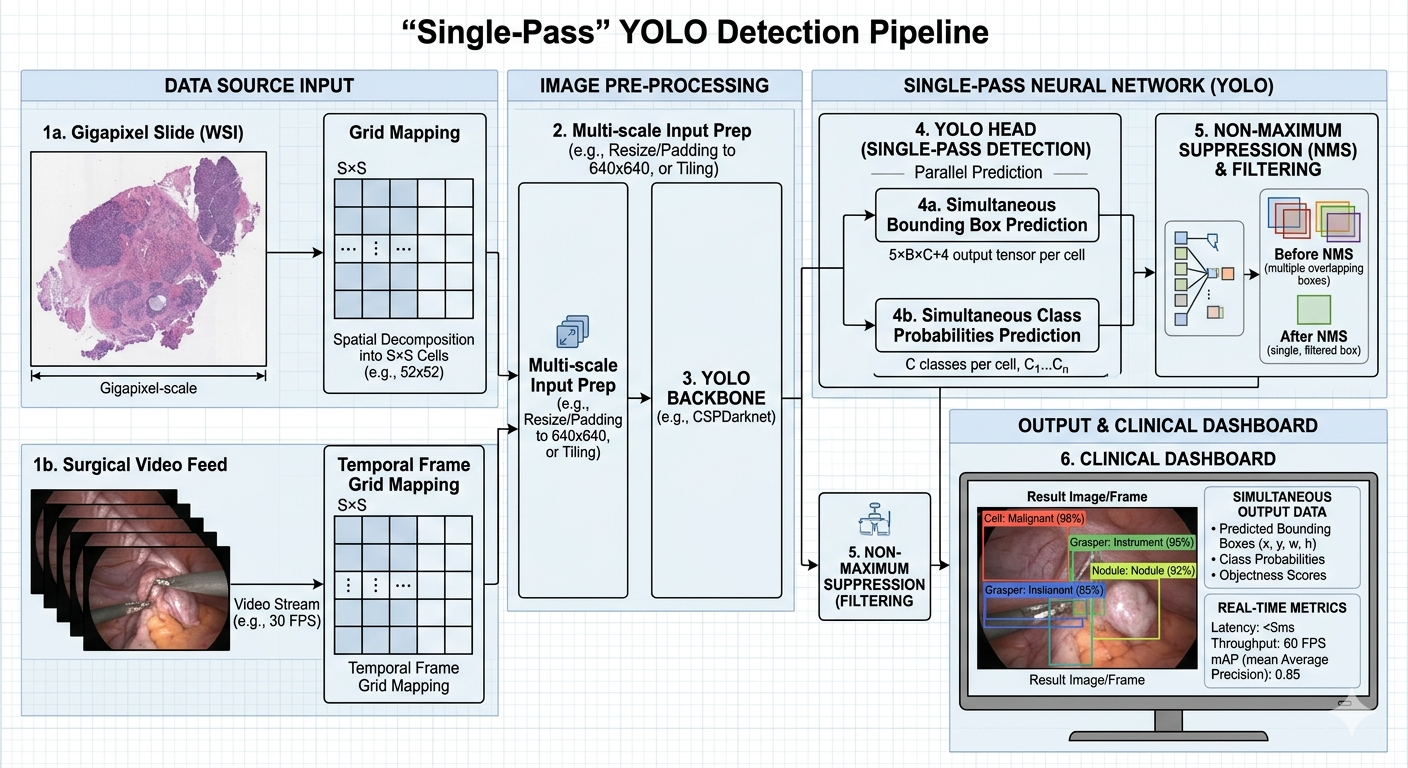
The Architectural Advantage: YOLO looks at the entire surgical video frame or pathology slide exactly once. It divides the image into a grid. For each grid cell, it simultaneously predicts multiple bounding boxes and the clinical class probabilities for those boxes.
See content credentials Article content Because it frames object detection as a single regression problem rather than a multi-step classification pipeline, it operates at blistering speeds. By optimizing these models using TensorRT and deploying them on edge GPUs within the surgical tower, we can achieve multi-object tracking at 60+ FPS, completely eliminating the “Latency Trap” we discussed in Part 5.
Clinical Applications of High-Speed Detection When you successfully transfer this architecture into MedTech, the ROI is immediate:
Digital Pathology Automation: A YOLO-based pipeline can scan a digitized tissue slide in seconds, drawing bounding boxes around every anomalous cell, instantly calculating ratios, and presenting the pathologist with a pre-analyzed dashboard. The pathologist shifts from searching to verifying. Surgical Instrument Tracking: By detecting and tracking instruments in real-time, the system can automatically log surgical phases, measure instrument trajectory for training purposes, and ensure 100% accountability of all surgical materials before the patient is closed.